
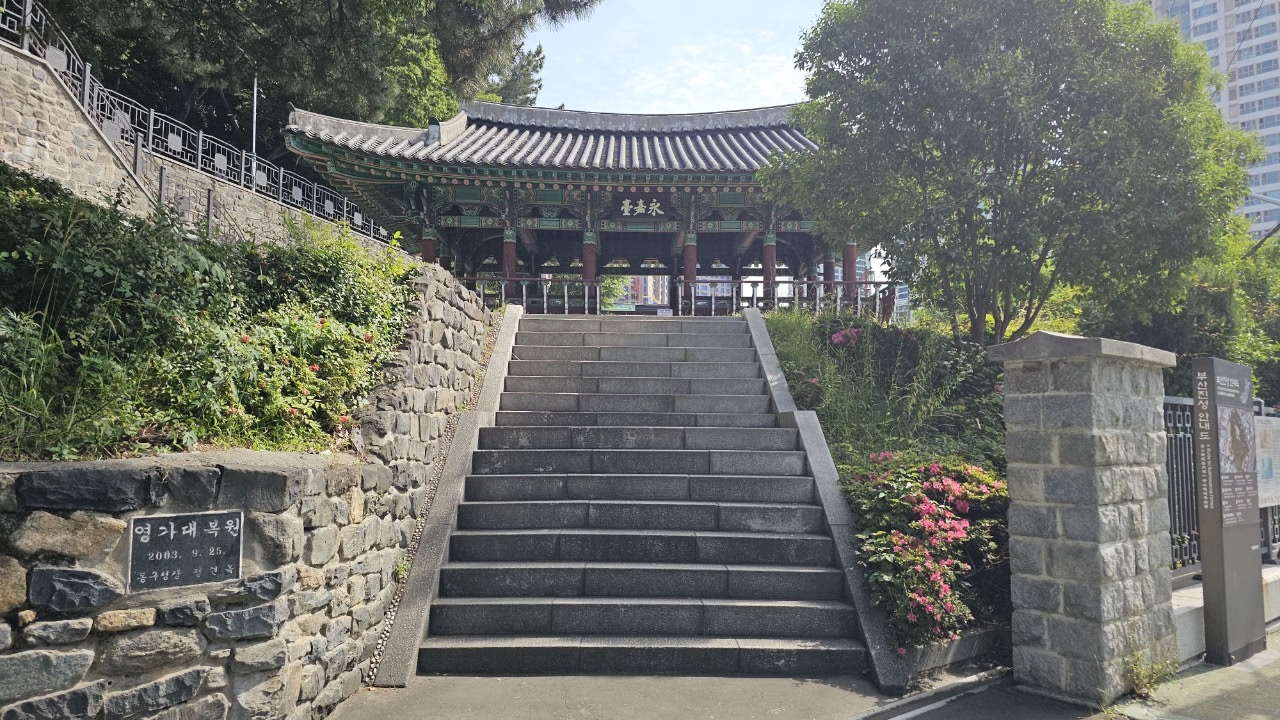
Course 7 picks up where Course 6 left off, at Yeongga-dae, and turns out to be one of the richest history walks on the entire Gamnaetgil trail — a compressed tour through Joseon-era diplomacy, colonial-era commerce, independence movement history, and modern Busan all inside about six kilometers. My friend Areum, unsurprisingly, was the one who suggested it.
Yeongga-dae itself is a restored pavilion marking the site where Joseon-dynasty diplomatic missions to Japan (tongsinsa) once set off by ship. A faded sepia photograph displayed nearby, dated to 1909, shows what the same spot looked like well over a century ago — a scattering of tile-roofed houses and bare trees around a tidal pool, almost unrecognizable next to the high-rises that surround it today.
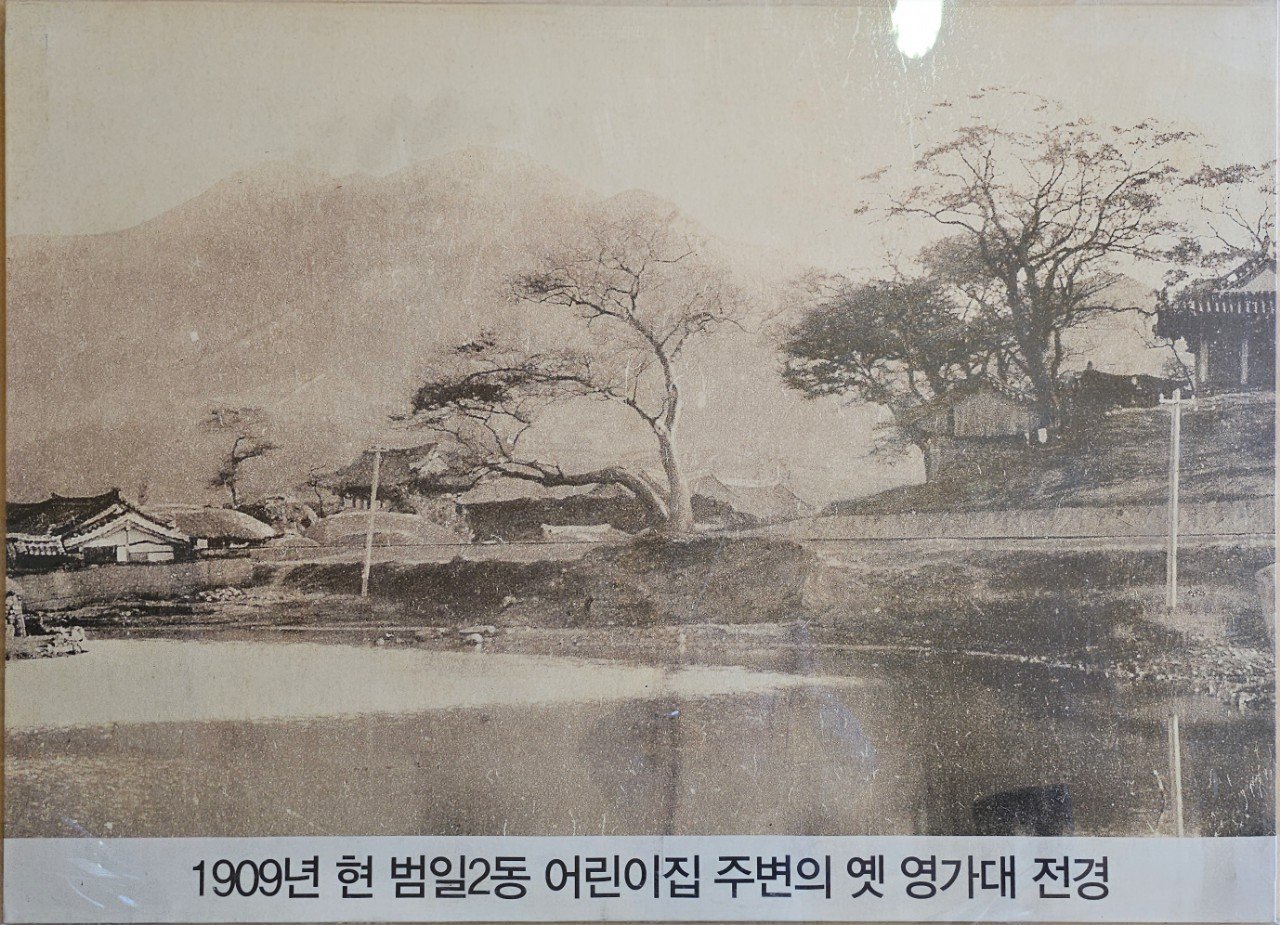
A 1909 photograph of the Yeongga-dae area, displayed at the modern pavilion.
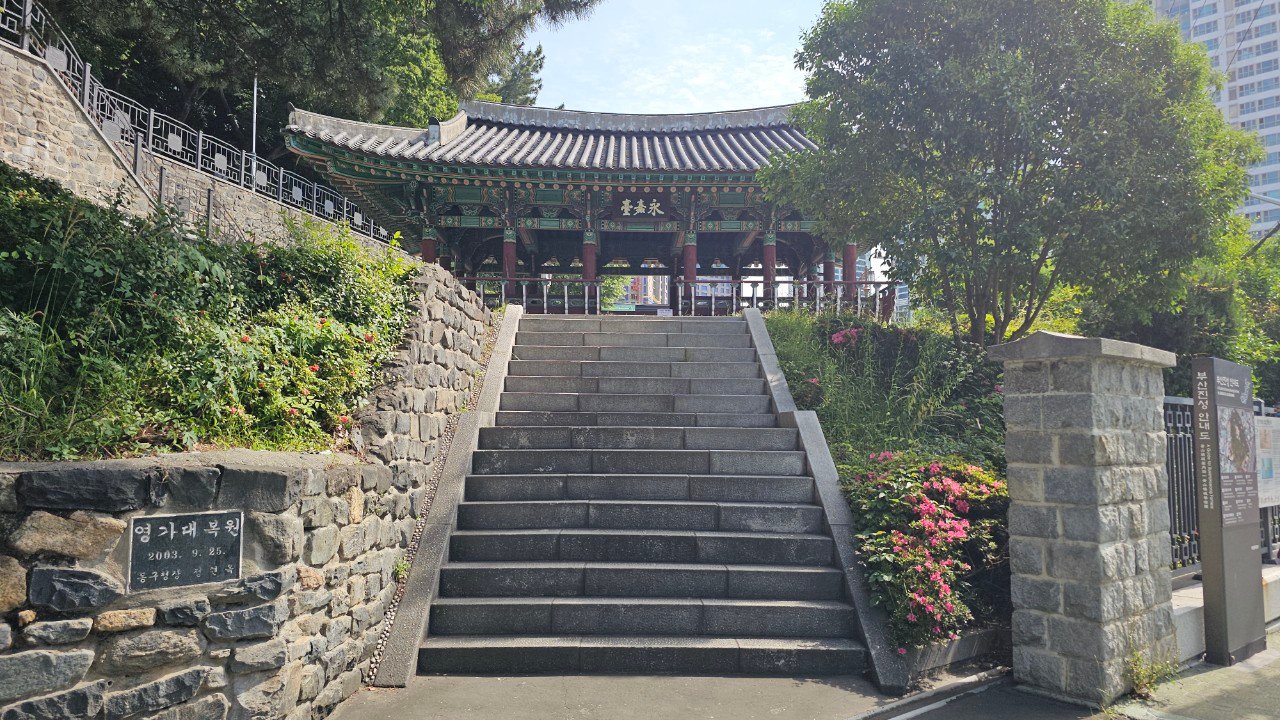
The restored Yeongga-dae pavilion as it stands today.
Route order
Busanjin Market to the mission hospital
From Yeongga-dae the trail runs through Busanjin Market, a century-old market still operating today, and past a stretch of furniture workshops in Jwacheon before reaching Ilsin Christian Hospital — founded by Australian missionaries and notable for opening one of Korea’s first dedicated maternity wards during the Korean War, staffed in part by the missionaries’ own daughters, who trained as doctors and nurses.
Jeonggong-dan and the Ilsin Girls’ School
A short walk further brings you to Jeonggong-dan, a memorial altar honoring Korean soldiers and civilians who died defending Busanjin fortress during the 1592 Japanese invasion. Areum spent a long time here reading the historical plaques, and I’ll admit her running commentary made the quiet grounds hit differently than they would have solo.
From there, the trail passes the former site of Ilsin Girls’ School, Busan’s first school for women, established by the same Australian mission — a reminder of how much of this area’s modern infrastructure traces back to a handful of 19th and early 20th century missionary institutions.
Independence history and Jeungsan Park
The route continues uphill past the March 1st Independence Declaration monument, marking where Busanjin Girls’ School students read the 1919 declaration of independence from Japanese rule, and then climbs toward Jeungsan Park via what’s genuinely called the “stairway to heaven” — a long, steep flight that had both of us stopping to catch our breath twice. The view from the top, out over the port and the surrounding hills, made the climb worth it.
Seongbuk Market and Gubongsan’s healing forest
Past the park, the trail descends into Seongbuk traditional market and its associated webtoon-themed street art, then climbs again into Gubongsan’s healing forest, a pocket of pine woods with a small foot-bathing area and quiet walking paths that feel worlds away from the dense urban blocks just below.
Choryang Ibagu-gil to Busan Station
We passed Yu Chi-hwan’s “Happy Postbox,” a monument to the poet known for writing love letters from this neighborhood, before descending through Choryang Ibagu-gil — a steep hillside neighborhood famous for its narrow alleys and sweeping port views — and finishing at Busan Station, officially closing out one of the most densely historical sections of the entire trail.
Trail info at a glance
- Distance: approx. 6 km
- Walking time: 3.5–4 hours, including stops at historical sites
- Difficulty: Moderate — several steep staircases, including the climb to Jeungsan Park
- Start: Yeongga-dae
- Finish: Busan Station
- Best for: history and architecture, not scenery — this is Gamnaetgil’s most urban, culturally dense section
Map of the route
The route at a glance
A few practical notes
Wear good shoes — the climbs to Jeungsan Park and through Choryang Ibagu-gil are genuinely steep staircases, not gentle inclines. Give yourself extra time at Jeonggong-dan and the independence monument if history interests you; this course rewards a slow pace far more than most Gamnaetgil sections. Busan Station at the finish connects to the KTX line and the subway, making this an easy course to end a longer trip on.
For more on Busan’s transit connections from the station, see our guide to getting around Busan.
Walked on a sunny early-June day, warm enough to make the Jeungsan Park stairs feel harder than they probably are.
More walks nearby
Other walks in Busan Station, Yeongdo and Songdo on this site: