
Nineteen sessions into a 28-course walking program, our Traveler’s School cohort had earned a proper reward: a full autumn field day built right into Manbo Course 21, complete with games most of us hadn’t played since childhood. My friend Seoyeon and I gathered with the group at Gupo Station under a genuinely clear late-November sky, the kind of crisp autumn day that makes every plan feel like a good idea.
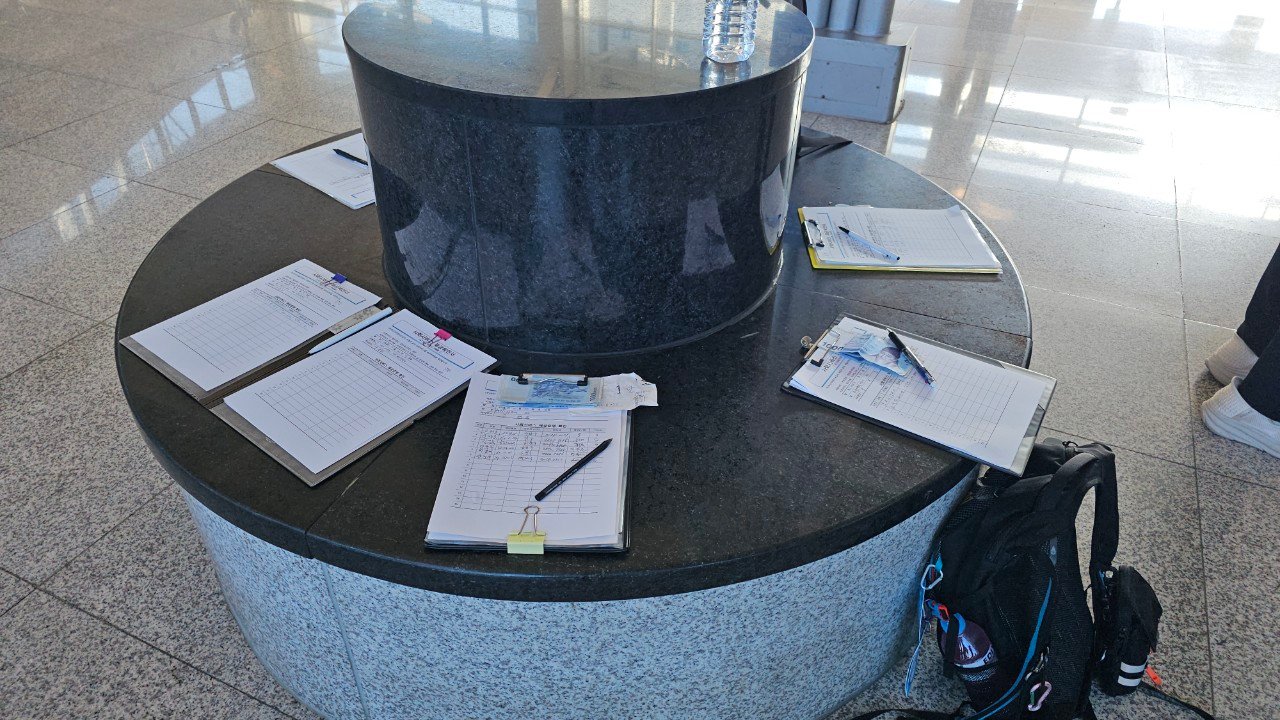
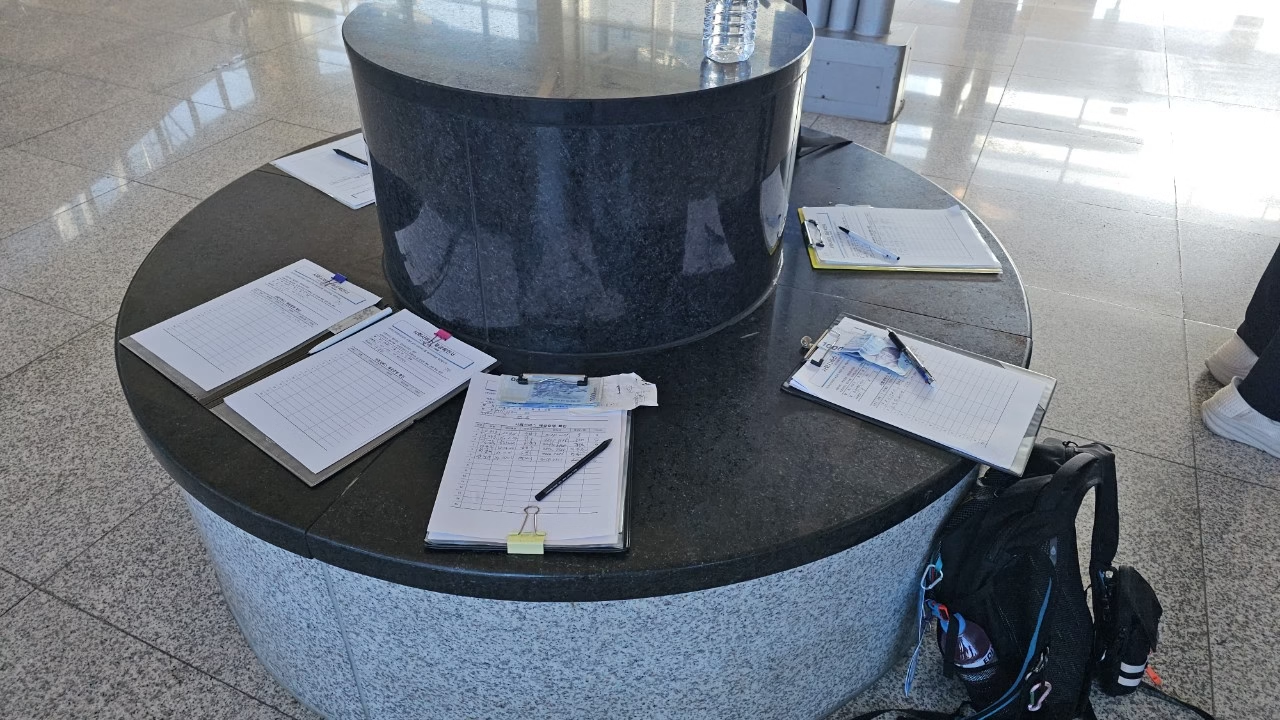
The sign-in table at Gupo Station, clipboards and donation forms ready before the walk began.
Route waypoints
Into Hwamyeong’s silver grass fields
From Gupo Station, the trail follows the Nakdong River past Gamdong Ferry Riverwalk into Hwamyeong Ecological Park, where silver grass stood taller than most of the group and caught the autumn light in a way that had everyone reaching for their phones. Past a water sports complex and a patch of burning bush shrubs arranged almost like a deliberate art installation, the park’s metasequoia trees added their own deep red to the mix — genuinely one of the better stretches of fall color on any Gamnaetgil-network walk this season.
Lunch under the bridge, then a field day
The group stopped for lunch near Hwamyeong’s Daecheoncheon bridge, gimbap passed around as usual, before continuing to Daecheoncheon Nuri-gil’s children’s forest area — the day’s real destination. There, waiting with genuine enthusiasm, the program’s organizers had set up a full autumn field day: shoe-throwing target practice, ring toss, and jegichagi (a traditional Korean shuttlecock-kicking game), split into team competitions with real prizes on the line.
Games, rivalry, and good humor
Scores from shoe-throwing turned out to be far less predictable than anyone expected, ring toss proved harder than it looked for every single competitor, and jegichagi came down to genuinely close margins between evenly matched teams. When the final scores were tallied, there was a brief hush before celebrations broke out — fourth place, then third, then a tense two-way tie for second before the top team took their win with the kind of unrestrained joy usually reserved for actual sporting events rather than a walking club’s lunch break.
Cooling off at Geumjeongsan’s West Gate
After the games wrapped, the group continued through Hwamyeongsu Arboretum’s own excellent fall color, past the day’s second stamp checkpoint, before a final forested climb toward Geumjeongsanseong’s West Gate — also known as Haewolmun, notably positioned in a valley rather than on the ridge like the fortress’s other gates. Reaching it marked the end of Course 21 and, more quietly, the unofficial start of the group’s final stretch: only six more sessions to go before graduation.
Trail info at a glance
- Distance: approx. 9.2–10 km
- Walking time: about 3–4.5 hours, including an extended rest stop
- Difficulty: Easy to moderate — flat riverside and park paths, with a forested climb near the finish
- Start: Gupo Station
- Finish: Geumjeongsanseong Fortress West Gate (Haewolmun)
- Best season: Autumn, for the silver grass and metasequoia color in Hwamyeong Ecological Park
Map of the route
The route at a glance
A few practical notes
Hwamyeong Ecological Park’s silver grass and metasequoia trees peak in late November, making this one of the best-timed autumn walks in the Gamnaetgil network. The final climb toward Geumjeongsanseong’s West Gate is the only real elevation gain on this route, so save some energy for it. Gupo Station makes for easy access by subway at the start.
For getting to Gupo Station, see our guide to getting around Busan.
Walked in late November under a clear autumn sky, the nineteenth session of a year-long walking course, complete with a group field day.
More walks nearby
Other walks in Nakdong River, Gangseo and Gadeokdo on this site: