
Most of the Gamnaetgil trail is about coastline and rivers, so Course 7-3 stands out — it’s the one section that trades sea views for history, looping through the old center of Dongnae, Busan’s historic seat of government long before the modern port city grew up around it. My friend Areum, who studied Korean history in university and has strong opinions about it, had been wanting to do this one specifically, so on a cold, clear January morning we met at Suan Station to start.
The temperature the day before had dropped to some of the lowest readings of the winter, so we bundled up more than usual before heading down into the underground history museum built right into the Suan Station complex — a genuinely unexpected find for a subway stop.
Route order
Underground history at Suan Station
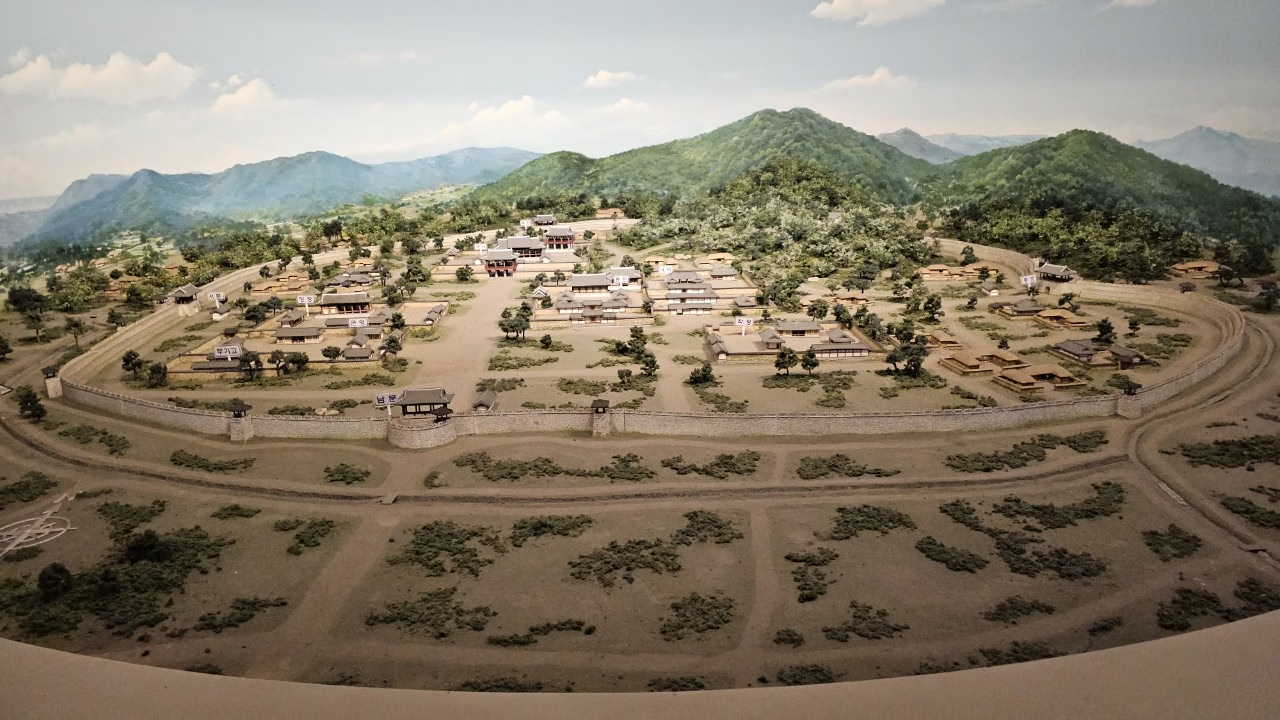
Suan Station sits on top of the site where, during construction, workers uncovered part of the old Dongnae Eupseong fortress moat, along with the remains of soldiers and civilians who died defending the town during the Imjin War invasions of the 1590s. The station now houses a small but well-done museum about it — battle flags, excavated arrowheads, and a large scale model of what the fortress town looked like at its height, walls, gates, and all.
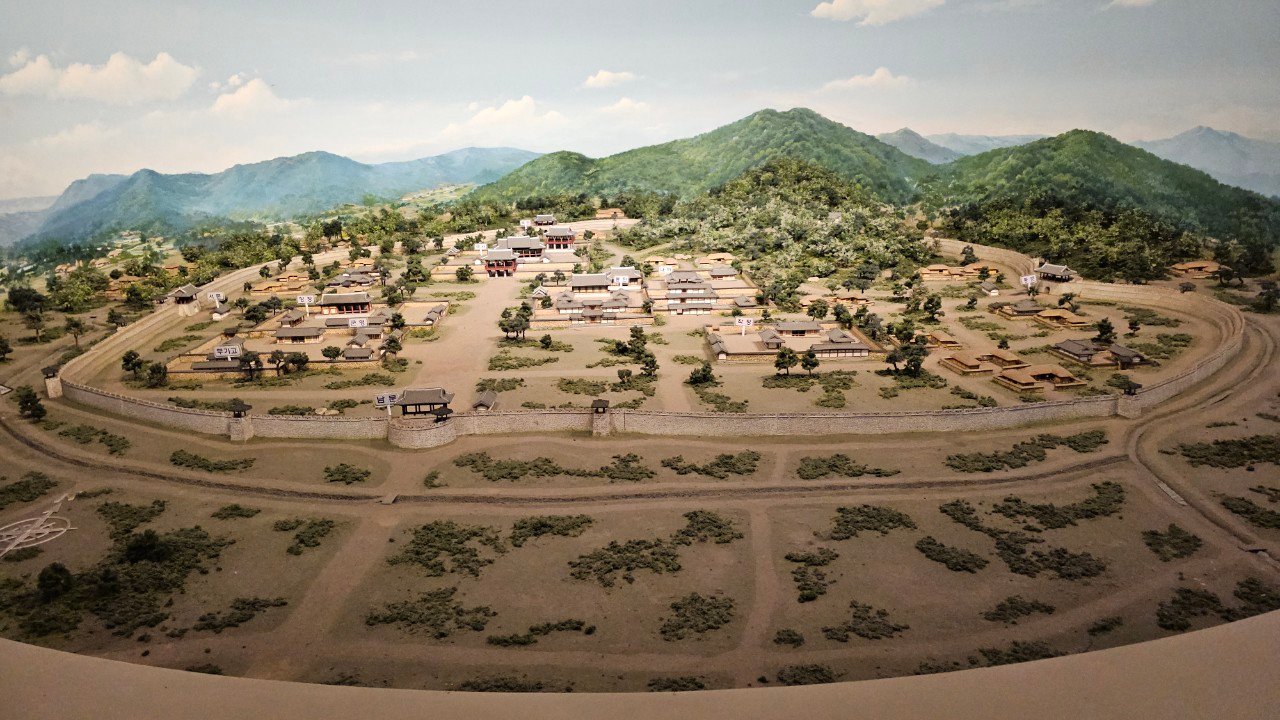
A scale model of Dongnae Eupseong as it stood centuries ago, on display at Suan Station.
Areum spent a good ten minutes longer than me looking at the model before we finally climbed back up to street level and out through exit 7, past a stall selling the neighborhood’s famous hotteok, toward the old government district.
Dongnae Government Office and the old market
Dongnae’s former government office complex — Dongnae-bu Dongheon — is where the district’s magistrate once handled official business, and the compound today includes several restored buildings you can walk through freely, including Chungsindang, the main hall. We wandered the courtyard, tried our hand at a traditional ring-toss game set up for visitors, and read through the history of Songgongdan, a memorial altar nearby honoring those who died defending the fortress in 1592.
From there the trail runs straight into Dongnae Market, an old-school covered market that’s been operating for generations. We stopped for the neighborhood’s famous hotteok — a filled, fried pastry that’s a genuine local specialty here — before continuing on toward the birthplace of Park Cha-jeong, an independence activist during the Japanese colonial period, and her siblings Park Mun-hui and Park Mun-ho.
Chungnyeolsa Shrine and Insaengmun Gate
Chungnyeolsa Shrine, a short walk further, honors the roughly 93 people — soldiers, civilians, and officials — who died in the 1592 defense of Busan against the Japanese invasion. Areum, predictably, had a lot to say here about the historical context, and I’ll admit it made the quiet shrine grounds land differently than they would have otherwise. The pond near the entrance was frozen solid, and a crepe myrtle tree stood bare against the winter sky — striking even without leaves.
Past the shrine we climbed a small hill and came down the other side to Insaengmun, the “Gate That Saved Lives” — according to local history, townspeople who fled through this gate during the 1592 invasion all survived, giving it its name. It was rebuilt in 2005 after being lost during the Japanese colonial period.
Bokcheon-dong Tombs and the fortress walls
The trail continues to Bokcheon-dong, home to an excavated tomb complex from the ancient Gaya confederacy, laid out now as an open-air museum with grass mounds and a scattering of old pottery on display — some of it, Areum pointed out, looking deceptively like junk until you learn what it actually is. From here we climbed toward Bukjangdae, the northern command post of the old fortress wall, for a genuinely wide view over Dongnae — Gwangan Bridge, Hwangnyeongsan, and much of eastern Busan visible on a clear day like ours.
We followed the fortress wall to Bukmun (North Gate), then passed through the Jang Yeong-sil Science Garden — dedicated to the Joseon-era inventor born in this district — before finishing at Seojangdae, the western command post, and finally Dongnae Hyanggyo, the old Confucian academy, where renovation work was underway the day we visited.
Trail info at a glance
- Distance: approx. 7 km
- Walking time: 3–3.5 hours, including museum and shrine stops
- Difficulty: Easy, with one moderate climb up to Bukjangdae
- Start: Suan Station (Busan Metro Line 4) — visit the underground history museum before you start walking
- Finish: Dongnae Hyanggyo
- Best for: history-minded travelers; this is the most culturally dense Gamnaetgil section, not the most scenic
Map of the route
Dongnae history route
A few practical notes
From Dongnae, Gamnaetgil continues on toward the reservoir and river stretch of Course 8-1 and 8-2: Hoedong Reservoir to Millak Bridge, a good next outing if you want more distance.
Give yourself extra time here if you actually like history — the Suan Station museum alone is easy to spend thirty minutes in, and both Chungnyeolsa and the Dongnae government office reward a slower pace. If you like a cold-weather outing, our trip to Wondae-ri Birch Forest in Inje is a snowier version of the same idea, further afield. Dongnae Market is a good lunch stop; the hotteok stalls near the entrance are locally famous for a reason. Because this course is almost entirely urban, it’s walkable year-round, though a clear winter day like ours gives the best visibility from Bukjangdae.
For more on navigating Busan’s subway system to reach starting points like Suan Station, see our guide to getting around Busan.
Walked on a clear, very cold January morning, a day after one of the coldest readings of the winter.
More walks nearby
Other walks in Northern hills: Beombangsan to Hoedong Reservoir on this site: